
Blog · 2026-11-24
Why One Room Is Always Dustier Than the Rest of the House
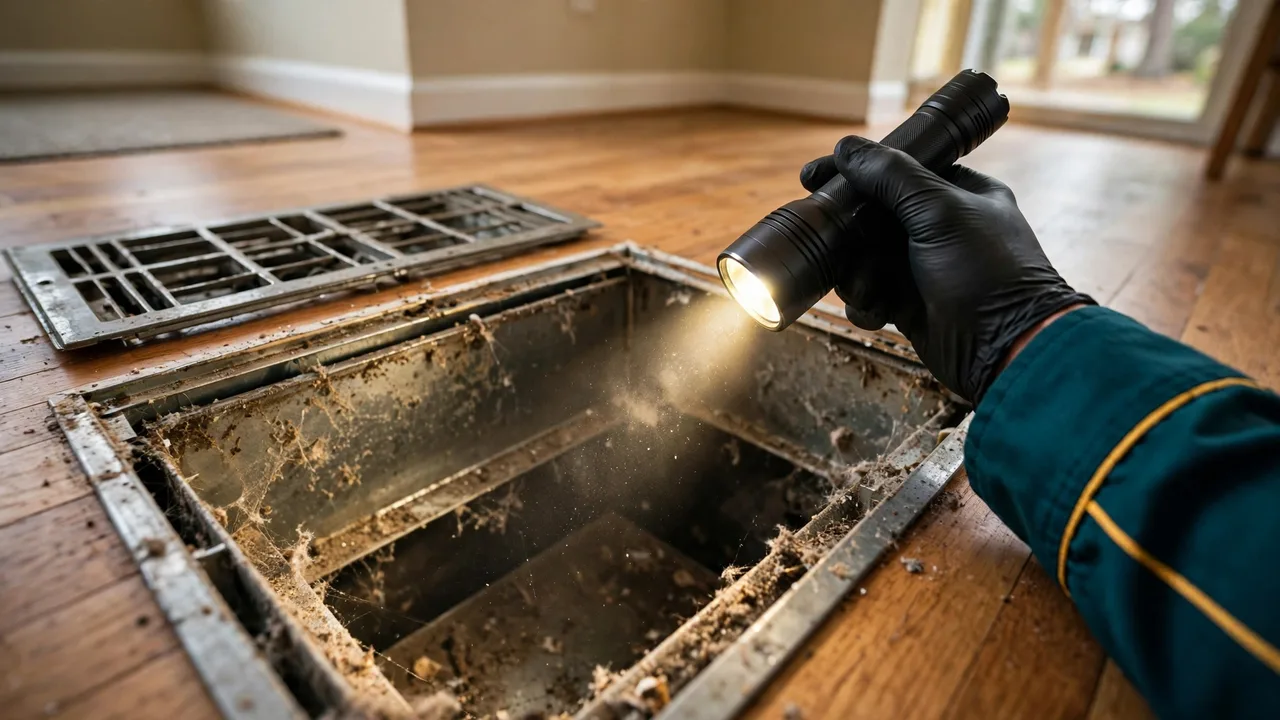
The fast answer: when one room gets dusty again within days while the rest of the house stays reasonably clean, the cause is usually local to that room's branch of the duct system — a supply run that is shedding stored buildup, a return path that is blocked or missing, a register that leaks dust around its edges, or a run that was partly crushed or disconnected and now moves air the wrong way. Dust that behaves differently in one room is information: it tells you exactly which run to inspect first, instead of guessing at the whole house. A camera inspection of that one branch usually settles it in a single visit.
First, rule out the room itself
Some rooms honestly do make more dust than others. A bedroom produces bedding fibre and skin flakes all night. A room with a litter box, a dog bed or a craft table loads its own air. A room over a garage or beside an attic hatch can pull in fine dust through gaps every time the system runs and the pressure changes. Before blaming the ductwork, check the obvious: is the dusty room also the pet room, the laundry-folding room or the room whose door stays closed all day? If the extra dust follows the activity, housekeeping is the answer. If the room is used like every other room and still coats itself first, look at the duct branch that serves it.
Cause 1: that room's supply run is shedding
Every supply run collects its own share of dust over the years, and runs do not load evenly. The longest run in the house — often to the far bedroom at the end of the hall — collects at its bends and low spots, and it is also the run whose air arrives slowest, so loosened material settles and re-lifts there first. Watch the register when the system starts: a visible puff, or a grey fan pattern spreading on the wall or ceiling around that one vent, means that branch is shedding stored buildup into the room on every cycle. Our guide to the signs ducts need cleaning lists the whole-house version of this pattern; when it shows up at a single vent, the branch is the story.
Cause 2: the room has no working return path
Air delivered to a room has to get back out, or the room pressurizes and the air finds its own exits — under the door, around the register boot, through gaps into wall cavities — stirring and depositing dust as it goes. Many Maryland homes have one large central return per floor rather than a return in every room, which works only while doors stay open or undercut enough for air to escape. A bedroom door that stays closed all day, in a home in Beltsville, Silver Spring or Columbia, can turn that room into the dustiest in the house without anything being wrong with the ducts themselves. The test is simple: leave the door open for a week. If the dust slows noticeably, the return path was the problem — as our explainer on return vents versus supply vents sets out in full.
Cause 3: the register boot leaks around its edges
The metal boot behind a floor or ceiling register is supposed to seal tight to the duct and the floor or drywall around it. When that seal fails, every cycle pulls a little air — and fine dust — from the wall cavity, attic or crawlspace side and delivers it around the edges of the register, where it lands as the dark halo and gritty film homeowners notice on the floor or ceiling nearby. This dust often looks different: greyer, grittier, more like construction dust than household fluff, because that is closer to what it is. Sealing a boot is a small, targeted fix, but finding it matters — cleaning the ducts alone will not stop a leak that keeps importing new dust from outside the system.
Cause 4: the run is damaged, sagging or partly disconnected
A flexible run stepped on in an attic, sagged between its hangers or partly pulled loose at a collar changes how that room's air moves. Weak, slow delivery lets dust settle in the room instead of being carried to the return and the filter, and a loose joint can spill conditioned air — and pull dusty attic air back in — at the same time. This is also the usual story when the dusty room is also the room that is always too hot in summer and too cold in winter. Dust plus a temperature complaint in the same room is a damaged-run pattern until a camera proves otherwise.
What a proper fix looks like
Start with the branch, not the whole system. The camera travels that room's supply run and the nearest return, and the picture separates the four causes above: a loaded run gets cleaned as part of a full-system cleaning done to our cleaning standard; a boot leak gets sealed; a crushed or disconnected run gets named plainly as a repair, not disguised as a cleaning problem; and a return-path problem often costs nothing more than a door habit or a furniture move. Homes across Rockville, Bethesda, Bowie and Laurel run into the same short list — the room changes, the causes repeat.
When the whole house is dusty, not just one room
If every room coats at the same speed, the branch theory no longer fits — that is a system-wide load, a filter problem, or a system that has simply reached its cleaning interval. The distinction matters because it decides the job: one branch inspected and fixed, or the full system cleaned. Either way, the evidence comes first and the recommendation follows it, with before-and-after photos from inside your own ductwork.
Let the dusty room point at the problem
A single dusty room is not a mystery to live with — it is a map. Tell us which room it is and what the dust looks like, and we will inspect that branch first. Call Eagle Air Duct Cleaning at (855) 640-0404 — answered 24/7 — or use the lead form on this page to book a camera inspection or a cleaning. Every quote is free, and we serve Beltsville and communities across Maryland, Washington DC and Northern Virginia.
Questions we hear on this topic
Because dust that concentrates in one room usually has a local cause: that room's supply run shedding stored buildup, a blocked or missing return path, a register boot leaking dusty air from a wall cavity or attic, or a damaged run moving air poorly. A camera inspection of that one branch identifies which.
It can — especially when the same room is also too hot in summer and too cold in winter. A crushed, sagging or partly disconnected run weakens delivery to that room and lets dust settle instead of reaching the filter. The camera shows the run's condition directly, so the fix matches the cause.
If the cause is a loaded supply run, yes — that run is cleaned as part of a full-system cleaning. If the cause is a leaking register boot, a return-path problem or a damaged run, cleaning alone will not solve it, and we will tell you which fix the room actually needs before any work starts.
Want us to look inside your ducts?
Book a cleaning or a camera inspection — and get the seasonal free dryer vent cleaning with a full duct cleaning, same visit.